
Compare Your Golf Club Distances to PGA Pros
Ever wondered how your driver or 7-iron compares to the average on Tour? Enter your stock carry distances and find out.
See How You Stack Up Against the Pros
Unlike a standard distance calculator, this tool compares your club distances directly against 2023 PGA Tour Trackman Averages. Enter your “Stock” carry below — the distance you reliably hit the ball with a smooth, normal swing, not your absolute maximum drive.
Two golfers with the exact same swing speed can see vastly different results depending on how they deliver the club to the ball. Select your profile below so we can calculate your “Real Average.”
See How You Stack Up Against the Pros
Select your swing profile, then enter your stock carry distance for each club you carry. Leave clubs you don't have blank.
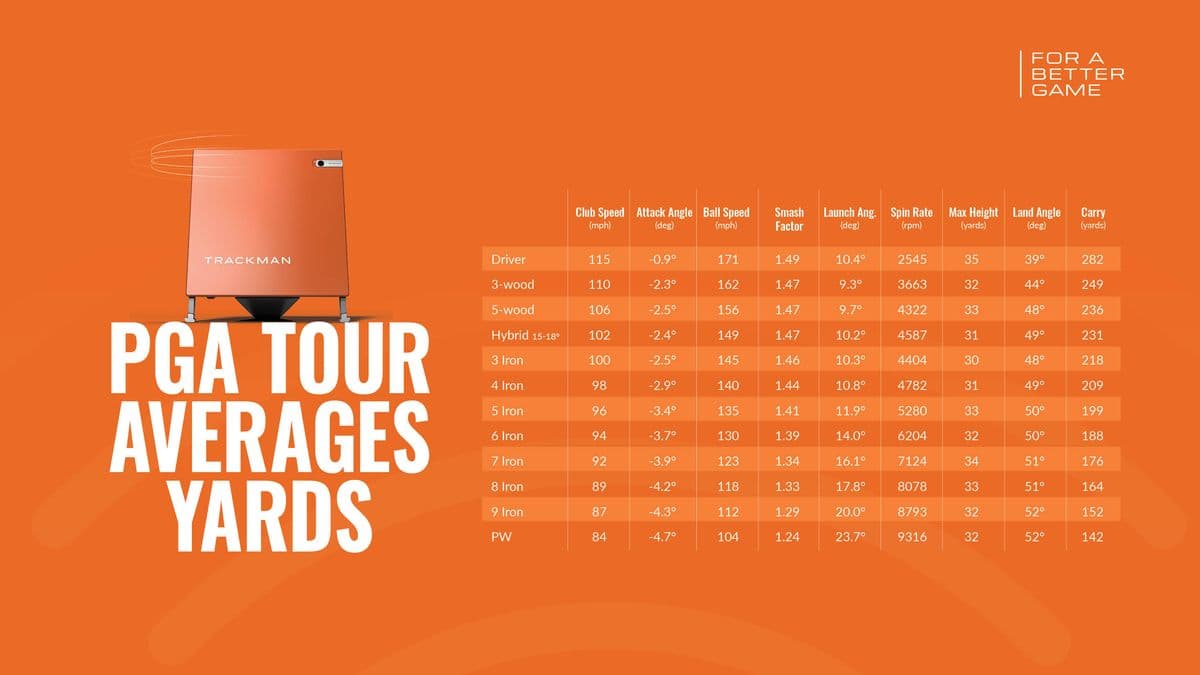
PGA Tour Launch Conditions Reference
Driver
115 mph Club Speed
10.4° Launch Angle
2,545 rpm Spin Rate
7 Iron
92 mph Club Speed
16.1° Launch Angle
7,124 rpm Spin Rate
Pitching Wedge
84 mph Club Speed
23.7° Launch Angle
9,316 rpm Spin Rate
What is Your “Real Average”
Your “Stock” carry is what you believe you hit each club. Your “Real Average” is what you actually hit when we account for the inefficiencies in your swing profile. The tool applies a proprietary efficiency algorithm based on three variables:
Strike Quality (Smash Factor)
Amateur golfers rarely hit the center of the face as consistently as a Pro. A mishit off the toe or heel reduces ball speed significantly. The calculator applies a consistency modifier based on your handicap range to simulate real-world amateur ball striking, rather than PGA Tour perfection.
Ball Flight (Vector Efficiency)
A straight shot travels the shortest distance to the target. If you selected a “Slice” or “Hook,” you are losing forward distance to side-spin. Draws typically produce lower spin and more roll, while fades generate higher spin and steeper landing angles.
Ball Trajectory (Landing Angle)
Shots that “Balloon” (spin too much) or “Run” (launch too low) fail to carry hazards and hold greens. A mid trajectory provides the ideal balance of carry and roll for most golfers.
Understanding Your Gapping Analysis
The tool automatically flags three types of gapping issues in your bag:
Bunching
When two clubs travel roughly the same distance — often the 4-iron and 5-iron. This means you're carrying a redundant club. A golf club fitter can replace “bunched” long irons with Hybrids or High-Loft Fairway Woods that are easier to hit and provide better distance separation.
Gap Alert
Gaps exceeding 18 yards between consecutive clubs indicate you're forced into awkward swing adjustments to cover those in-between yardages. A loft and lie adjustment machine can often fix this in minutes by bending your irons to space them out evenly (e.g., 4° of loft between each club).
Inverted
When a shorter club carries farther than a longer one, it signals a severe equipment mismatch. This is likely a shaft that is too heavy or stiff for that particular club. A professional fitter can diagnose and fix this quickly.
Using This Data to Improve Your Game
Don't Swing Harder, Fit Smarter
A proper driver fitting alone can yield 10–20 yards of carry without changing your swing speed. The right shaft, loft, and head combination optimizes launch conditions to maximize the distance your swing already produces.
Trust Your “Real Average”
Play the “Real Avg” column on course rather than your “Stock” numbers. It feels good to pure a 7-iron 175 yards once, but if your Real Average is 158, playing to 175 will leave you short most of the time. Scoring is about playing the percentages, not the highlight reel.
Fill the Void
If you see a 25-yard gap between your 3-wood and your longest iron, you're missing a club. That gap on the course means forced lay-ups or risky swing adjustments. Identify the missing clubs and work with a fitter to eliminate dead zones in your bag.
Pros Don't Guess. They Get Fit.
Every player you just compared yourself to spent hours on a launch monitor before their irons made it into the bag. PGA Tour averages aren't a lucky accident of swing speed. They're the output of a fitting process that locks in shaft, length, lie, loft, and head model around the specific way that golfer delivers the club. The reason a tour pro's 7-iron flies the same number every time isn't talent. It's equipment that fits.
If your numbers came out 30+ yards short of tour averages, that's expected, and not a problem to fix at the range. But if your gaps are inconsistent, or one club refuses to do its job, or the longest club in your bag mysteriously goes shorter than the next one down, that's an equipment story, not a swing story. The fix is the same one tour players use.
The honest version of this comparison: you don't need tour speed to get tour-quality gapping. You need someone with a launch monitor watching the strike, spin, and descent angle of every club in your bag and adjusting until the gaps are even. That's a fitting. When you're ready, find a fitter near you and close the gap the way the pros do.
Data Source & Methodology
The PGA Tour averages used in this tool are derived from TrackMan's latest 2023 PGA Tour Averages, which tracks real-time performance metrics during tournament play across 40+ events and 200+ players.
All yardages displayed are Carry Distances — the distance the ball travels through the air before landing. Roll is not factored in, giving you a cleaner comparison for approach shots and club selection.
Disclaimer: This tool provides estimates based on averages. External factors like wind, temperature, elevation, and equipment technology will always play a role in exact yardages. The best way to know your real numbers is to book a fitting with a launch monitor.
Frequently Asked Questions
How do amateur distances compare to PGA Tour pros?
The gap is widest at the top of the bag and narrows as you go down. Tour players average around 300 yards off the tee against roughly 240 for the average male amateur, but a tour 7 iron travels about 172 yards against 145 or so. Wedges are closer still. Distance is not what separates most amateurs from professionals, consistency of strike and control of spin are.
Why do tour players hit the ball so much farther?
Clubhead speed and quality of contact. Tour averages sit near 113 to 115 mph with the driver against 90 to 94 for a typical amateur, and they find the center of the face far more often, which raises ball speed for the same swing. Their equipment is also built to their exact launch and spin numbers rather than bought off a rack.
Is tour distance data carry or total?
The driving distance statistic you see on television is total distance measured on two holes per round, so it includes roll and favours firm fairways and downwind holes. Iron numbers quoted from Trackman are carry. This tool compares like for like, which is why your driver gap to a professional may look smaller here than the numbers you see quoted.
Should I try to swing like a tour player to gain distance?
Copying a tour swing rarely transfers, because it is built on mobility and practice volume most golfers do not have. Speed gained without control usually costs more strokes than it saves. A better sequence is to fix strike quality first, make sure your equipment is not limiting your launch and spin, and add speed through proper training afterwards.
How much distance can equipment realistically add?
For most amateurs, 10 to 20 yards on the driver, found by correcting shaft weight and flex, loft, and spin. That is the same order of magnitude as a season of speed training, available in an afternoon. Stock shafts are chosen to suit the widest possible group of buyers, so a golfer with an unusual tempo or transition is often losing yards to equipment rather than swing.
Are LPGA numbers a better benchmark for most golfers?
For many amateurs, yes. LPGA players average around 94 to 96 mph with the driver, which is close to a good male amateur and above many senior golfers. Their efficiency, launch conditions, and gapping are a far more realistic model than PGA Tour numbers, and their iron distances make a more useful comparison.
My distances are much shorter than the chart. Is something wrong?
Usually not. Most golfers compare their best ever shot against a tour average, which is not the same measurement. Take ten shots with a launch monitor, drop the best and the worst, and average the rest. If that number is still far below the chart for your swing speed, the likely causes are off center contact, spin that is too high, or shafts that do not match your delivery.
What is the fastest way to close the gap?
Measure, then fit. Know your real carry numbers for every club, get your gaps to a consistent 10 to 15 yards, and have a fitter check that your driver launch and spin are in range for your speed. Those three steps recover more yards for the average golfer than any swing change, and they hold up under pressure because nothing about your technique has to change.
Other Free Golf Tools
- Swing Weight Calculator, find your club's swing weight from its total weight and balance point.
- Golf Club Length Calculator, check whether your irons, driver, and wedges should be standard, longer, or shorter.
- Golf Club Distance Calculator, estimate carry and total yardage for every club in your bag.
- Golf Elevation Calculator, adjust yardage for uphill, downhill, and altitude.